
Real Estate Marketing in 2026: Locality-First or Lose

In 2026, the agents winning real estate markets are not the ones with the largest inventory or the biggest brand. They are the Digital Mayors of their micro-markets: locally dominant, digitally visible across every channel, and knowledgeable enough about their neighborhoods to answer questions no algorithm ever will. The agents losing are the ones still marketing to a city when buyers only care about one thing: do you know my street?
Boost Your Business
Growth acceleration and brand strategy for real estate and property tech. 10+ years scaling agent productivity and brokerage growth engines across competitive markets.
Executive Summary
- 87% of homebuyers start their search online, with 93% using local search queries to find properties (Taboola, 2026).
- 59% of buyers cite neighborhood quality as a top purchase factor, ahead of price and home features (NAR Generational Trends Report, 2026).
- Google's Local Pack drives 44% of local search clicks, while the top organic result captures 27.6% of all clicks (Taboola, 2026).
- 52% of buyers found their home through an online channel, yet 88% still worked with an agent during the transaction (NAR, 2026).
- 87% of AI model recommendations are based on "Digital Share of Voice" how often a brand is mentioned across the internet, not just keyword rankings (DMR Media, 2026).
- The agents dominating 2026 are executing three to five strategies consistently and measuring results monthly, not chasing every new trend (Primestreet, 2026).
The paradox of real estate in 2026 is this: every buyer in the world starts their search on platforms they can access from their couch. Yet by the time they are ready to move, the decision hinges almost entirely on whether a real estate professional can answer hyperlocal questions no algorithm can. This year, neighborhood has become the new price.
The Buyer Who Researches Like An Investor, But Lives Like a Person
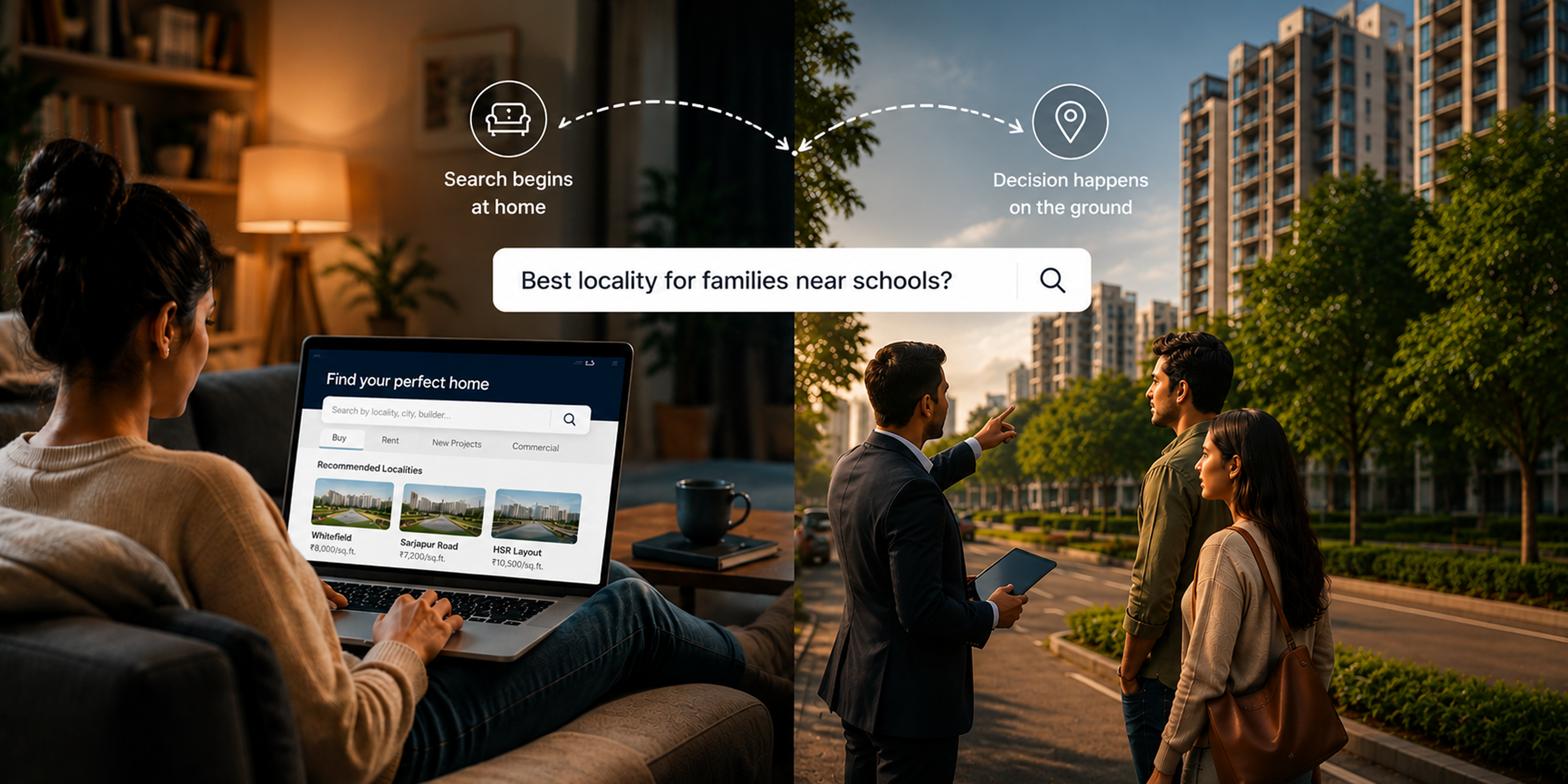
Homebuying behavior shifted permanently in 2026. Today's buyers research neighborhood appreciation rates, analyze local inventory levels, study school district rankings, and review future development plans before scheduling a single showing. Some compare multiple cities, counties, or even regions before narrowing their search.
But here is the twist: they are not buying like investors. They are just thinking like them. The top reasons buyers purchase a home are practical: more space (44%), owning instead of renting (41%), and finding a better neighborhood (36%) not wealth-building.
This hybrid buyer wants data and meaning. They will pull up commute times, school ratings, and crime statistics online. But they also want to know what the neighborhood feels like on a Sunday morning, whether the community is stable or shifting, and whether their family will thrive there in five years.
40% of buyers said their agent improved their understanding of neighborhoods they were searching a service buyers rank among the most valuable an agent provides (NAR, 2026). The agent's job has fundamentally changed: you are no longer introducing listings. You are answering the questions digital platforms cannot resolve.
Buyers spend a median of 10 weeks in the search process before purchasing. That is not indecision. That is due diligence. And every week of that journey, buyers are looking for someone who understands their market deeply enough to cut through the noise.
Platform Scale Meets Neighborhood Expertise: The Market's New Structure
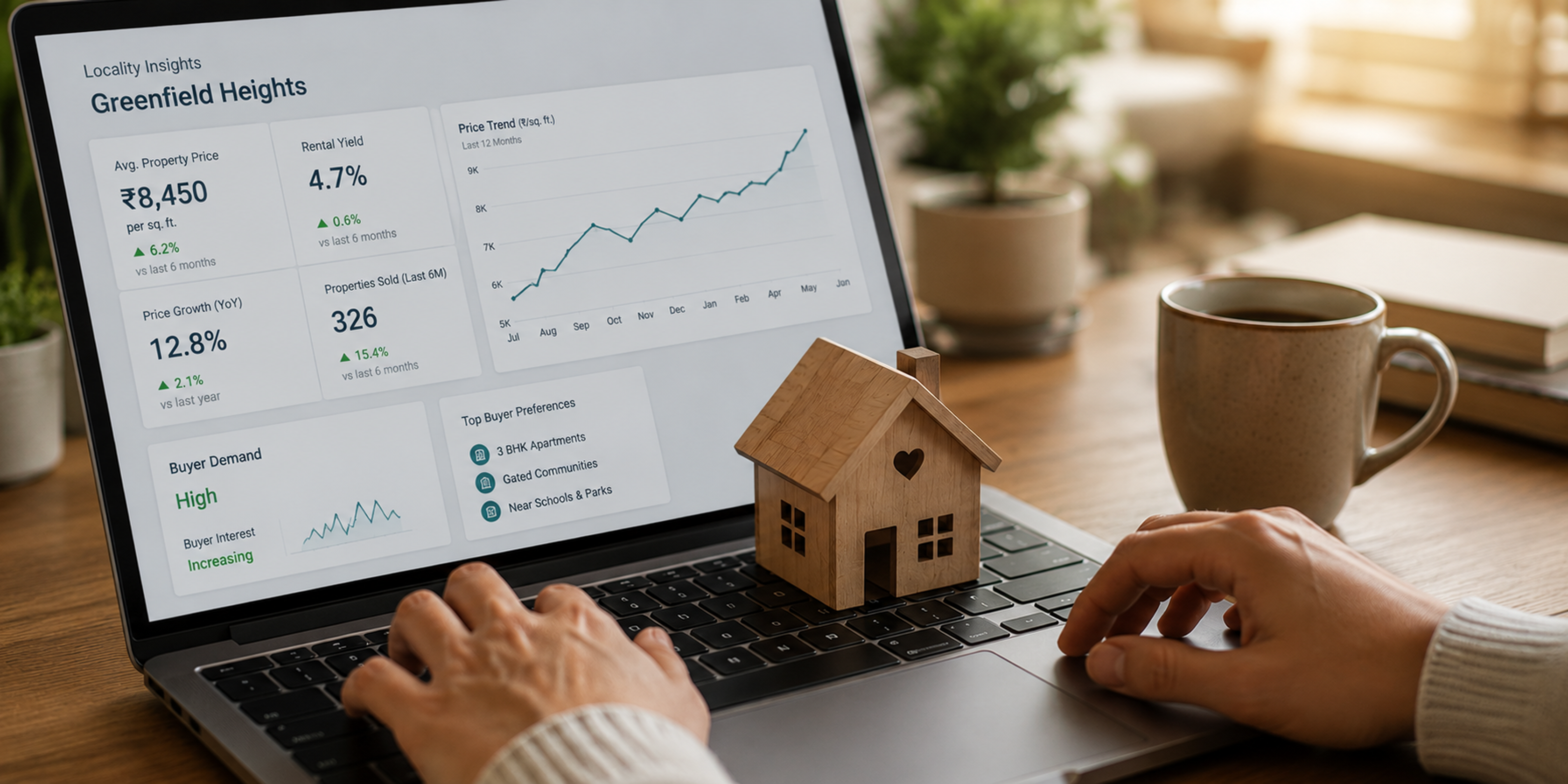
The real estate transaction now requires both global platform reach and hyperlocal expertise. Agents who master both win. Here is how the buyer journey splits between platforms and professionals:
| Buyer Stage | What Happens | Primary Player | What They Solve |
|---|---|---|---|
| Discovery | "I want to buy a home" | Zillow, Realtor.com, Google | Property availability, price range, basic location filters |
| Research | "Which neighborhoods fit my life?" | Digital platforms + blogs | Schools, commute, crime, amenities (but feel is missing) |
| Selection | "Why this neighborhood over that one?" | Real estate agent | Neighborhood nuance, market trends, community fit, off-market deals |
| Decision | "Will this be a good long-term choice?" | Real estate agent + community knowledge | Hyper-local expertise, relationship, guidance through complexity |
Why Hyper-Local Beats National Brand
The dominance of national platforms is real. Nearly 60% of buyers use Zillow, Realtor.com, or Redfin during their search, making them the single most influential discovery resource. But those platforms can't close deals. They can't answer why a neighborhood is worth a premium, or flag risks invisible to algorithms.
That's where locality becomes structural advantage.
Agents who position themselves as community experts—understanding local school ratings, the best coffee shops, neighborhood character—build stronger, more lasting client relationships. This isn't a nice-to-have. It's the price of entry in 2026.
The shift is dramatic. Remote and hybrid work has unleashed geographic flexibility that didn't exist five years ago. Buyers no longer search within a commute radius of their office. They search across cities, regions, even countries. But that freedom creates paralysis: too many options, too little context.
Agents who fill that gap own the market. You're not competing on commissions or transaction volume anymore. You're competing on whether you can convincingly argue that this neighborhood, with this community character, this school district, and this trajectory is the right long-term choice.
The data backs this up. 56% of buyers said finding the right property was the most difficult step, not inventory volume, but neighborhood fit. The problem isn't supply. It's clarity. Buyers have access to thousands of listings but lack the local intelligence to evaluate which neighborhoods align with their life.

Neighborhood Quality is Now the Primary Decision Factor
This point cannot be overstated: neighborhood has moved from nice to have to primary dealmaker.
71% of homebuyers identify neighborhood quality as a primary dealmaker when evaluating properties, more than price, square footage, or any specific home feature. The neighborhood isn't the context for the home. It's the home itself.
What drives this? Partly remote work. Partly an aging population prioritizing lifestyle over square footage. Partly younger buyers thinking like investors about long-term community stability. But mostly it's clarity: for the first time, buyers have the data to evaluate neighborhoods rigorously, so they do.
Your role as a real estate professional has inverted. You used to sell homes located in neighborhoods. Now you sell neighborhoods that happen to have homes. Lead with the community. Follow with the property.
According to the 2026 NAR report, the brokerages pulling ahead are those who have made neighborhood intelligence accessible at every stage of the buyer journey. That's not a listing advantage. That's a positioning advantage.
The neighborhood factors that matter most have shifted too. Beyond traditional metrics like schools and commute, lifestyle factors rank high: lower cost of living (49%), better weather (47%), and general lifestyle improvements (42%) drive relocation decisions. This means your neighborhood positioning needs to answer not just "Is this a good place to live?" but "Is this the right place for how I want to live?"
The Digital Mayor: Hyper-Local Presence Across Every Channel
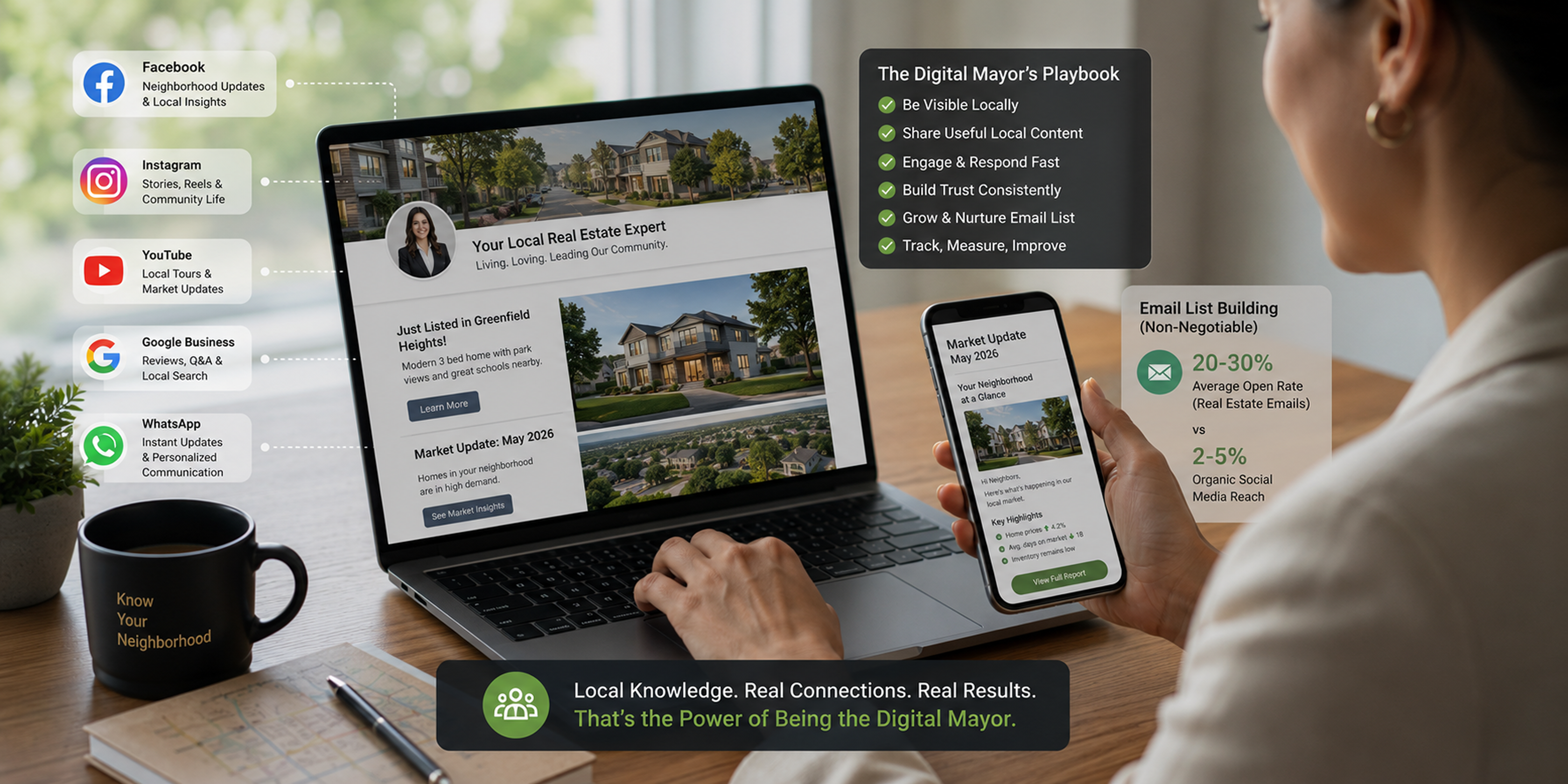
The term "Digital Mayor" has become shorthand in 2026 for the agent who wins: most visible, most authentic, fastest to respond. They're not scattered across platforms. They're dominant in their markets.
Here's what that looks like in practice:
| Channel | What They Do | Frequency | Goal |
|---|---|---|---|
| Google Business Profile | Post weekly with listings, neighborhood highlights, client testimonials | 1–2 posts/week | Own local search results; 44% of local search clicks come from Local Pack |
| Local SEO & Website | Neighborhood-specific landing pages, hyperlocal keywords, schema markup | Ongoing | Capture "real estate agent near me" and micro-neighborhood searches |
| Short-form Video | 60-second authentic clips: neighborhood walks, behind-the-scenes, market insights | 3–5/week | 78% of agents now use video as primary tool; it's shared 12x more than text |
| Email List | Weekly market reports, buyer guides, neighborhood analyses | 1–2/week | 20–30% open rate vs 2–5% organic social reach |
| Social Media | Behind-the-scenes authenticity, client stories, community events | Daily consistency | Build personal brand; show real work, not polished corporate messaging |
The Digital Mayor doesn't do everything—they do a focused set of channels, consistently, and measure what converts.
This consistency compounds. Agents who pick three to five strategies and execute them daily, then measure monthly and adjust quarterly, pull ahead of competitors. It's not about the trend. It's about the discipline.
The key is not adding more channels but deepening presence in fewer channels. Email inboxes put messages directly in front of people who already showed interest, with open rates for real estate emails averaging 20–30%, versus 2–5% organic social media reach. This is why email list building should be non-negotiable—it's the highest-converting channel once you have an audience.
How to Respond: Five Moves That Compound
- Own your local search footprint first. 93% of homebuyers use local search to find properties, and Google's Local Pack captures 44% of those clicks. Your Google Business Profile should be comprehensive, updated weekly, and optimized for neighborhood-level queries. This is your floor, not your ceiling. Post consistently. Share listings, community highlights, client reviews, and market insights. Google treats Business Profiles like mini social media accounts, and optimized profiles rank higher and dominate local search results. Complete every section. Collect reviews systematically. Respond to every review—positive and negative. This compounds over months into a defensible local position
- Build neighborhood pages that explain, not just list. Generic "homes for sale in [city]" pages rank for no one. Instead, create location-specific landing pages that answer buyer questions: commute times to major employment centers, school district performance over five years, local amenity maps, neighborhood demographic shifts, and future development plans. Make every page a buyer's guide to that neighborhood, not a listing dump. The goal is to own search for "real estate agent in [neighborhood]" and "what's it like to live in [neighborhood]." These hyper-specific queries have high intent and low competition compared to city-wide keywords.
- Become authentic on video, consistently. 63% of agents use video content in their strategy, but the successful ones prioritize raw, relatable content over polished productions. Film neighborhood walks. Share honest market updates. Respond to common buyer questions. Don't wait for perfection. Three imperfect videos per week beats one perfect video per month. The psychology here is simple: video builds trust faster than text. Authenticity creates a parasocial bond that makes the seller feel like they already know and trust you before you ever walk through their door. Raw, unpolished content outperforms high-production studio work because buyers have become skeptical of traditional sales messaging.
- Build an email list that generates recurring revenue. Email open rates run 20–30% versus 2–5% organic social reach. Weekly market reports, buyer guides, and neighborhood analyses convert curious browsers into engaged leads. This is how you stay top-of-mind for repeat business and referrals. Offer valuable lead magnets: "First-Time Buyer Guide," "Neighborhood Deep Dives," "Market Trends Report," "Home Valuation Report." Once someone subscribes, you have a direct channel to them every week. This is significantly more reliable than social algorithms.
- Build your personal brand, not your brokerage brand. When someone refers a real estate agent, they mention the agent's name, not the brokerage. Your market position, your content library, and your client relationships are your assets. Your brokerage provides infrastructure. Build portable equity through consistent positioning in your market. You survive brokerage changes. The brokerage brand doesn't survive agent changes anymore. This means creating content around your personal expertise and personality. Share your philosophy. Explain your market perspective. Show your work. The agents who build recognizable personal brands become the ones buyers ask for by name, not by brokerage. For a deeper guide on building hyper-local real estate positioning, see our strategy guide on locality-first growth for real estate teams
The Real Test: Consistency Over Trends
The agents finishing dead last in 2026 are the ones waiting for "the next big trend" while the market shifts beneath them. The ones finishing first are the ones who picked their market, mastered their channels, and showed up consistently as the expert everyone in town knows.
The buyer looking for a home isn't looking for a real estate agent. They're looking for a guide who understands their neighborhood, has skin in the community, and can explain why this place will matter to them in ten years.
Become that person. Become the Digital Mayor. Everything else follows.
Ready to build a locality-first strategy for your team?
Hyper-local positioning requires clarity on your market, consistency across channels, and discipline in measuring what converts. XCCELER works with real estate teams and brokerages to build growth engines that dominate local search while maintaining authentic community positioning.