
Why Most School Websites Lose Admissions Before the Form Load
Your school is not losing families because of fees, location, or the school down the road. It is losing them because the website makes applying feel like work.

Most school websites are built to impress visiting parents, not to convert them. That single design decision, prioritising visual prestige over conversion logic, is responsible for more lost enrollments than any competitor, fee structure, or catchment boundary. Schools invest in open days, social campaigns, and paid search, drive families to their website, and then watch 98% of them leave without raising a hand.
Picture your website as the reception desk at a hotel. A family walks in with luggage, ready to check in. The receptionist hands them a twelve-page form, tells them the key collection window is on page four of the site, and mentions the lift only works properly on a laptop. They leave. The hotel next door gets the booking. That is a reasonable description of the average school admissions funnel in 2026.
The solution is not a redesign. It is a diagnosis. Here are the four friction points that kill school website conversions before a family ever reaches the inquiry form.
Boost Your Business
Why the Problem Stays Hidden
The average admissions team measures success by the number of completed inquiry forms, not by the volume of families who arrived, looked around, and left quietly. That measurement gap is precisely why the problem compounds year over year without anyone calling it out.
Most private school websites convert fewer than 2% of visitors into inquiry form submissions, while the education industry median for dedicated landing pages sits at 8.4% (Unbounce, 2024). On a site with 10,000 enrollment-season visitors, the gap between 2% and 5% conversion represents 300 additional families in the pipeline, with identical traffic and identical marketing spend. The budget is not the problem. The conversion system is.
Only two-thirds of school marketers know their conversion goals inside their own analytics software, and just 20% have a plan to measure performance against yearly enrollment objectives (Unbounce, 2024). Without a benchmark, there is no feedback loop. The site looks good. Traffic ticks upward. Nobody notices the leak.
If you are not yet tracking conversion rate on your admissions pages, our guide on [School Website Performance Benchmarks] covers the five metrics that matter most and how to set them up.
Four Friction Points That Kill School Admissions Conversions
1. The Website Is Designed for a Board Presentation, Not a Busy Parent
The most common school website mistake is not a technical failure. It is an intentional one. School marketing teams optimise for peer comparisons and design awards. The result is a site that signals prestige beautifully and converts families terribly.
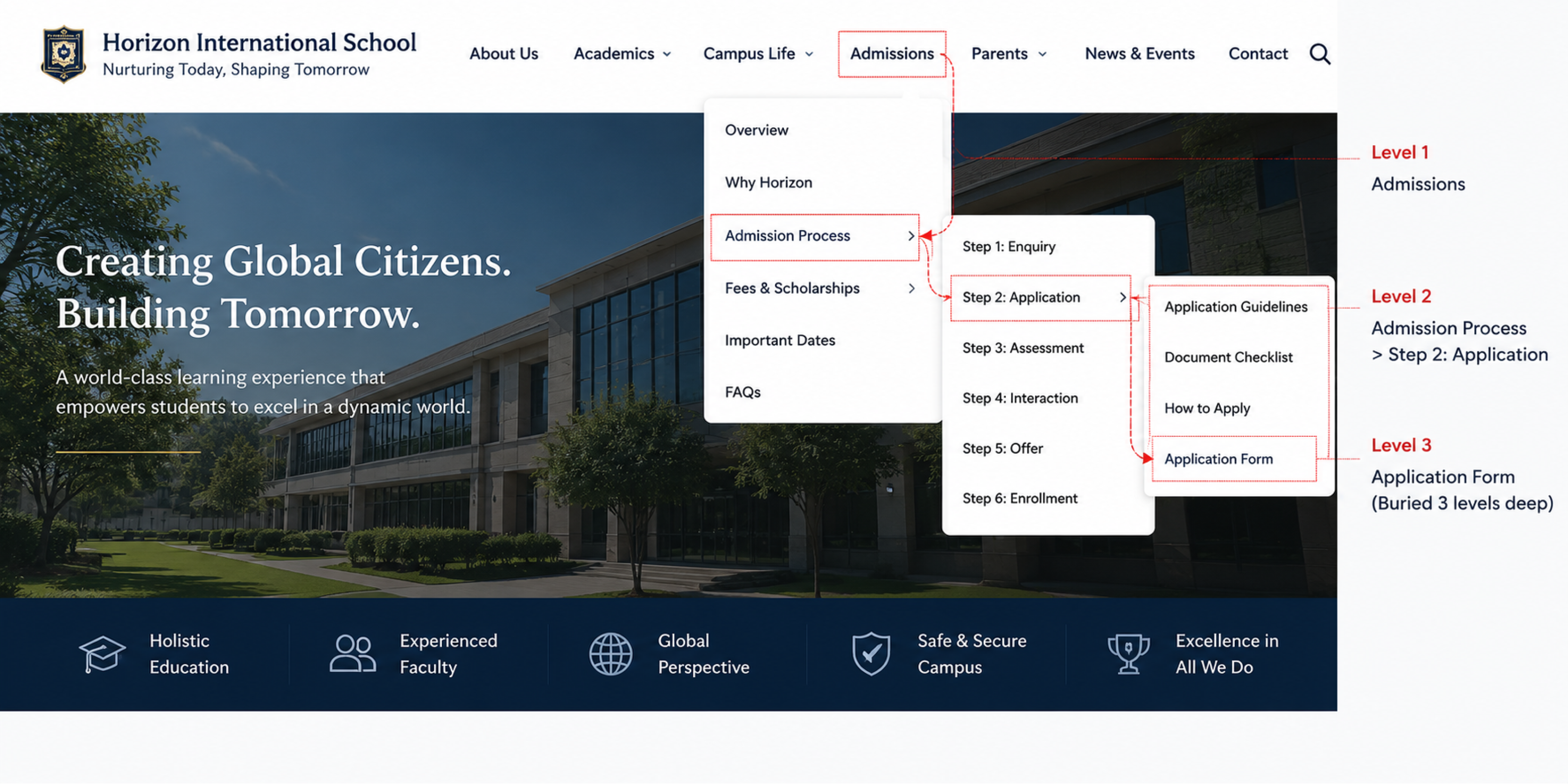
A parent discovering your school at 9pm on a Tuesday has one question: how do I find out more? If the answer requires three clicks through a navigation menu, a separate admissions portal login, and a page clearly designed for desktop, that parent is gone before they find the form. The inquiry form should be reachable in one click from any page on your site. Tuition information should be visible without a form fill. Every admissions page should carry one clear next step, not four competing ones.
| Action | Do | Don't |
|---|---|---|
| Inquiry form placement | One click from any page; visible above the fold on admissions pages | Buried inside a submenu under Admissions then Prospective Families then Get in Touch |
| Tuition information | Transparent, accessible without gating | Hidden behind a Request a Prospectus form requiring an email submission first |
| Page calls to action | One clear CTA per page matched to visitor intent | Multiple competing buttons: Apply Now, Download Brochure, Book a Tour, Call Us |
Read our piece on School Admissions Page Design to understand which structural decisions consistently reduce inquiry rates.
2. The Page Is Too Slow and Mobile Is Broken
A family finds your school through an Instagram story during a commute. They tap the link on their phone. Six seconds pass. The page is still loading. They close the tab. You spent budget getting them there. The mobile experience lost them before they read your school's name.
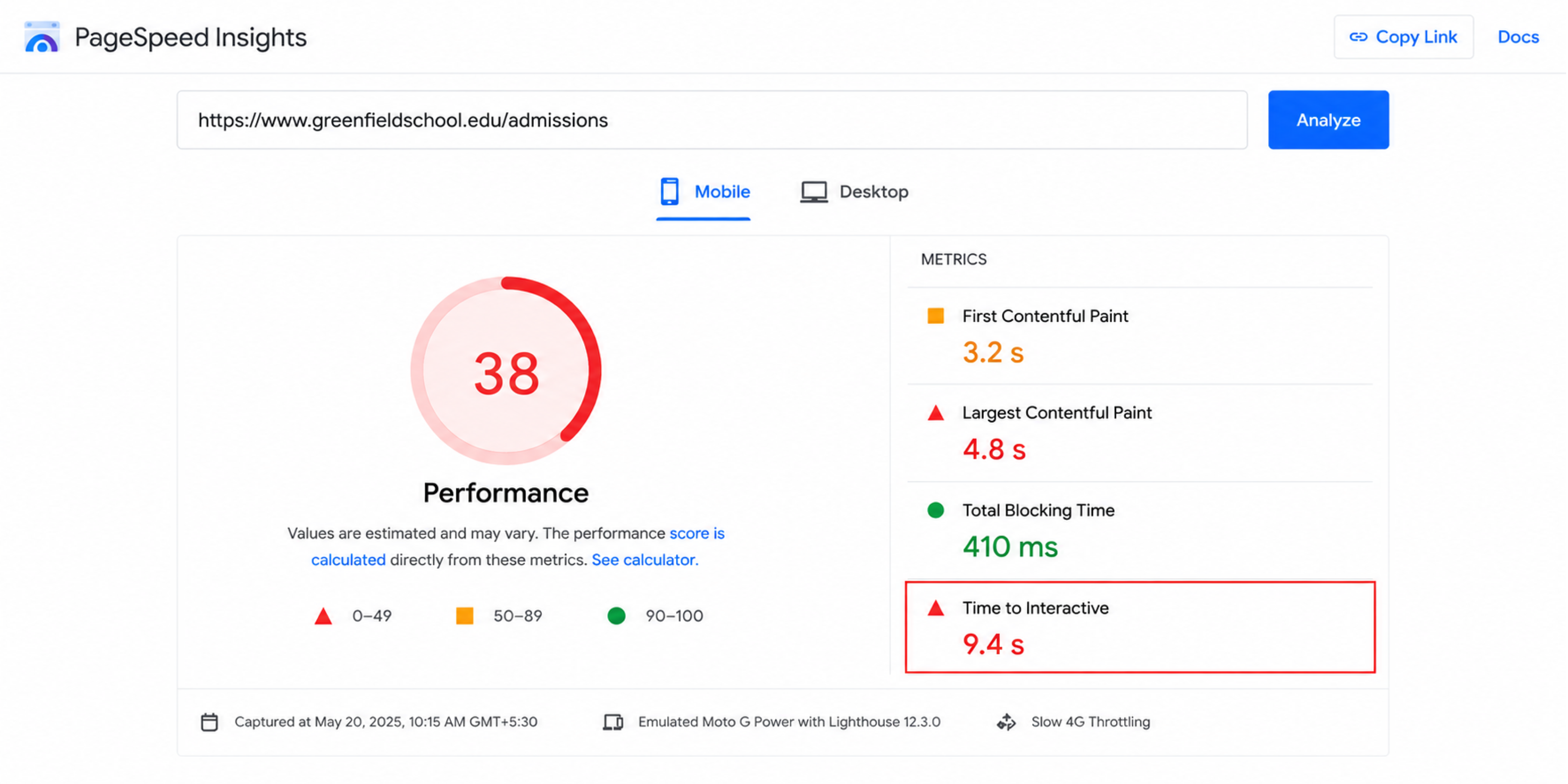
As page load time increases from one to five seconds, the probability of a mobile visitor bouncing increases by 90% (Google Think with Google). A two-second delay alone lifts bounce rates by 103%. Mobile pages on most school websites average 8.6 seconds to fully load (Tenet, 2025), against a user expectation of under two seconds. Every second beyond that is enrollment revenue leaving through the back door.
Mobile is not a secondary channel for school research anymore. Parents research schools between meetings, during commutes, and after the children are in bed. If your mobile experience requires pinching, zooming, or waiting, the school with the faster site wins the inquiry regardless of academic standing. Run Google PageSpeed Insights on your top three admissions pages today. A mobile score below 70 means the page is losing families before a single word of your content is read.
3. The Inquiry Form Is Asking for a Commitment Before the Relationship Has Started
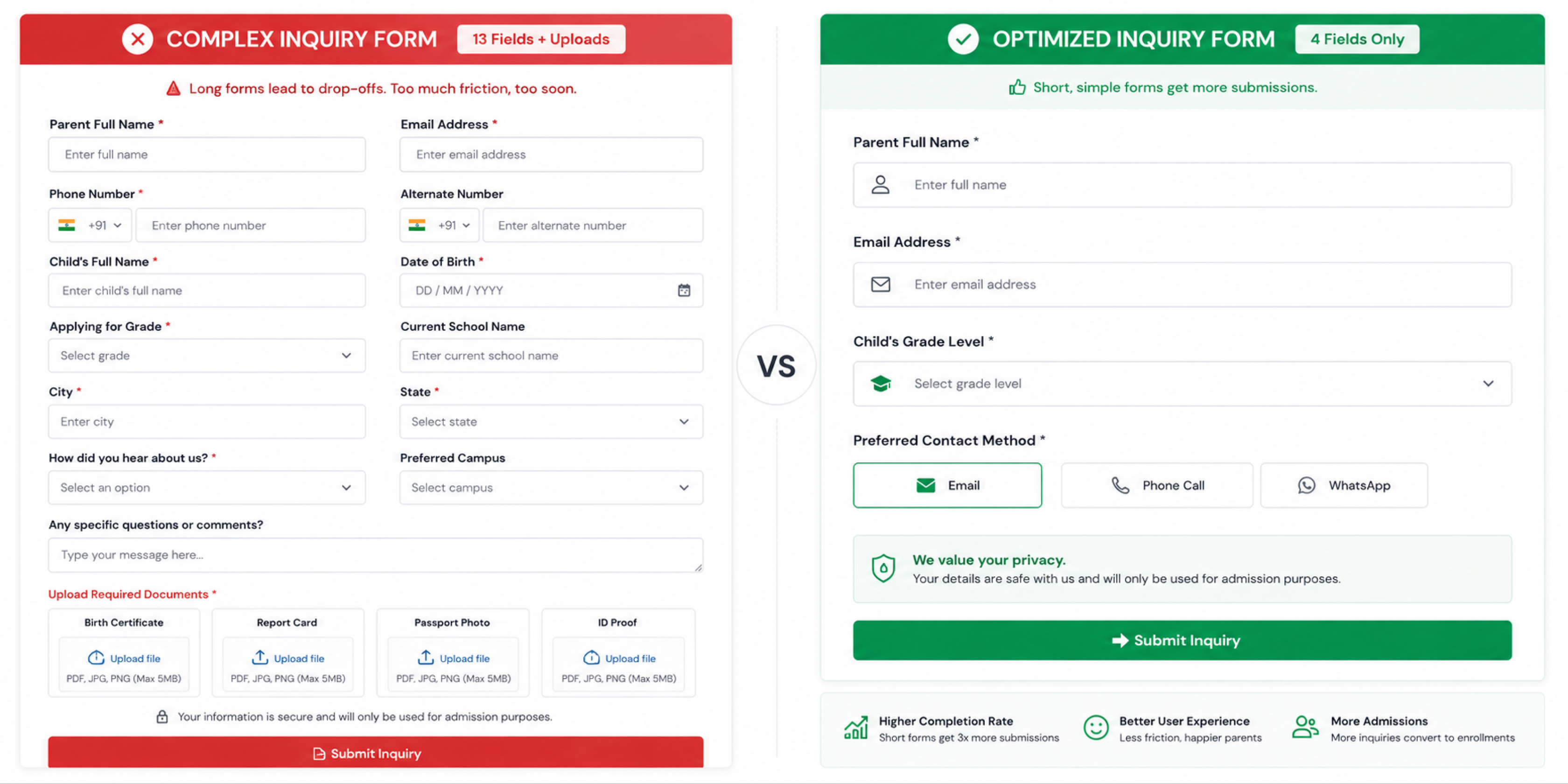
A family landing on your inquiry form for the first time is at the beginning of a conversation. They want to know if your school is worth a phone call. Your form is asking them to behave as though they have already decided.
As page load time increases from one to five seconds, the probability of a mobile visitor bouncing increases by 90% (Google Think with Google). A two-second delay alone lifts bounce rates by 103%. Mobile pages on most school websites average 8.6 seconds to fully load (Tenet, 2025), against a user expectation of under two seconds. Every second beyond that is enrollment revenue leaving through the back door.
Mobile is not a secondary channel for school research anymore. Parents research schools between meetings, during commutes, and after the children are in bed. If your mobile experience requires pinching, zooming, or waiting, the school with the faster site wins the inquiry regardless of academic standing. Run Google PageSpeed Insights on your top three admissions pages today. A mobile score below 70 means the page is losing families before a single word of your content is read.
| Action | Do | Don't |
|---|---|---|
| Initial inquiry fields | 4 to 6 maximum: name, email, grade, contact preference | Include document uploads, essays, or reference details at first contact |
| Multi-step applications | Show a clear step indicator so families know where they are in the process | Present a wall of fields with no visible end point or progress indication |
| Mobile form testing | Test on real devices; large tap targets, readable without zooming | Assume the desktop form experience translates to mobile without testing |
Read our piece on School Admissions Page Design to understand which structural decisions consistently reduce inquiry rates.
4. No One Is Watching for the Families Who Almost Converted
This is the most expensive friction point and the least visible one. A family starts filling in your inquiry form. They get four fields in and stop. No system flags it. No follow-up is triggered. The family moves on. Your admissions team never knew they were there.
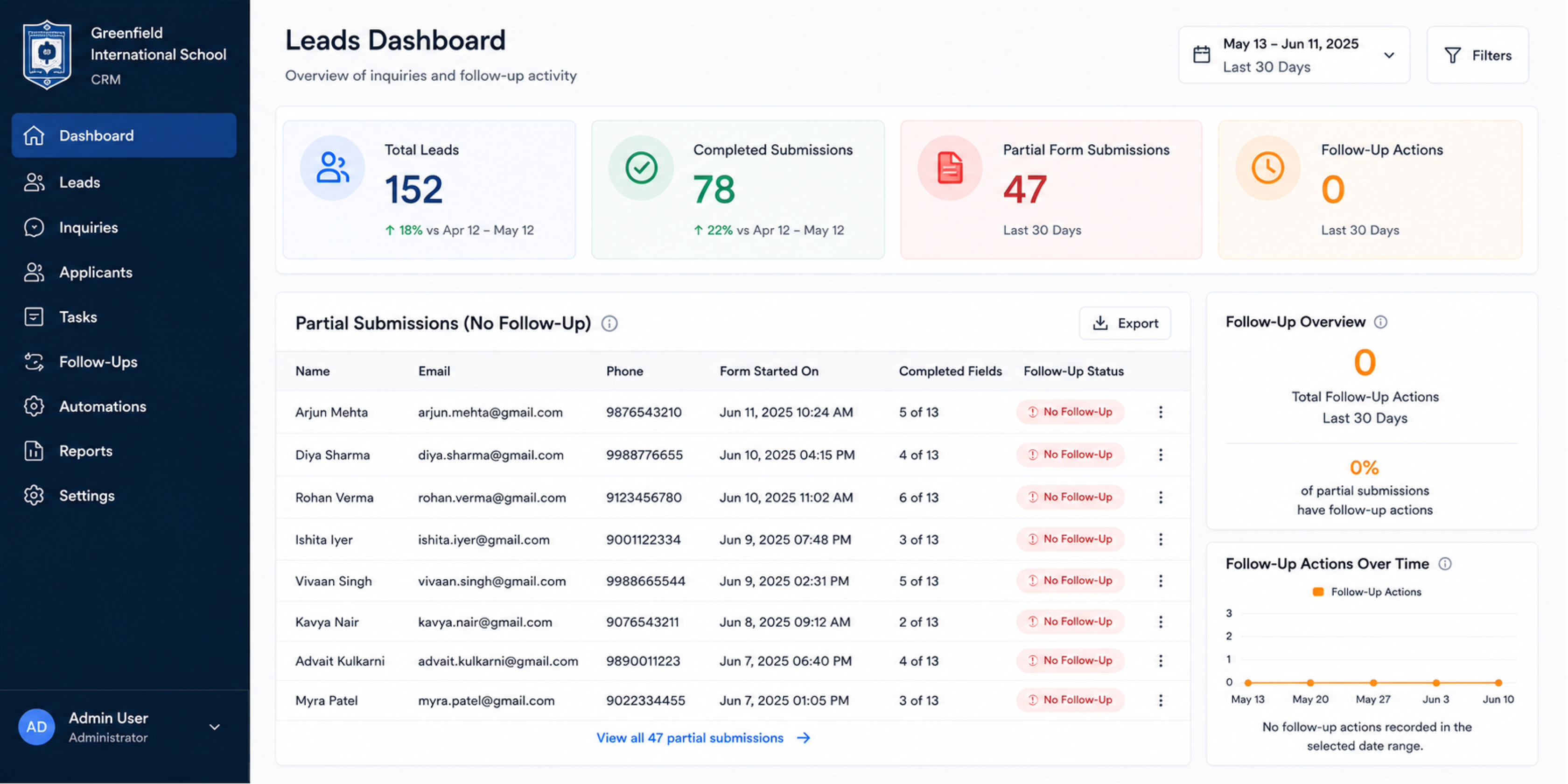
Up to 70% of school inquiries that are submitted never receive a direct human response (Element451, 2023). For partial submissions, the number is effectively 100%, because most schools have no mechanism to detect them at all. Email follow-up sent within 30 minutes of form abandonment recovers 8 to 15% of those lost applications, at near-zero cost (Acceleroi, 2026). That recovery rate compounds significantly over an enrollment season.
The response gap compounds the abandonment problem further. 78% of families enroll with the first institution that responds to their inquiry (LeadAngel, cited in Hyperleap AI, 2026). The average school takes 8 to 12 hours to reply. By that point, a competing school with a 30-minute automated acknowledgment and a same-day personal follow-up has already moved the family further down their funnel. Speed of response is not a nice-to-have. It is a structural enrollment advantage.
Read our piece on School Admissions Page Design to understand which structural decisions consistently reduce inquiry rates.
School Website Conversion: Tactics at a Glance
| Friction Point | Effort Required | Time to Impact | Best For |
|---|---|---|---|
| Surface inquiry form in one click from any page | Low | Immediate | Schools where form is buried three or more clicks deep |
| Fix mobile page speed to under three seconds | Medium | Two to four weeks | Schools with bounce rates above 55% on mobile pages |
| Reduce inquiry form to four to six fields | Low | Immediate | Schools seeing high drop-off on step two of multi-page forms |
| Set up partial form submission follow-up | Low to medium | One to two weeks | Schools with no system for re-engaging abandoned inquiries |
What to Do This Week
Before commissioning a redesign or increasing paid search spend, run a 30-minute conversion audit on your own website. Open your homepage on a mobile phone. Time how long it takes to load. Find the inquiry form. Count the clicks it takes to get there. Open the form and count the required fields. Then pull one number from Google Analytics: your inquiry form completion rate.
Those four data points will tell you exactly where the enrollment is leaking. The schools consistently outperforming their targets on modest budgets are not outspending their competitors. They are out-converting them, one friction point at a time.
Your website is your most cost-effective admissions officer. It works at midnight, on weekends, and during every school holiday. The question is whether the experience it is delivering earns the next step, or quietly sends families to a school that made it easier to say yes.
About XCCELER
XCCELER is a growth acceleration and brand strategy firm that partners with schools and organisations to design strategies and digital experiences that convert interest into action. Our work combines conversion-led thinking with brand precision, focused on the changes that move enrollment numbers without requiring a full rebuild.
Learn how XCCELER works with schools