Social Media Algorithms Explained: How Instagram, YouTube & LinkedIn Rank Content in 2026
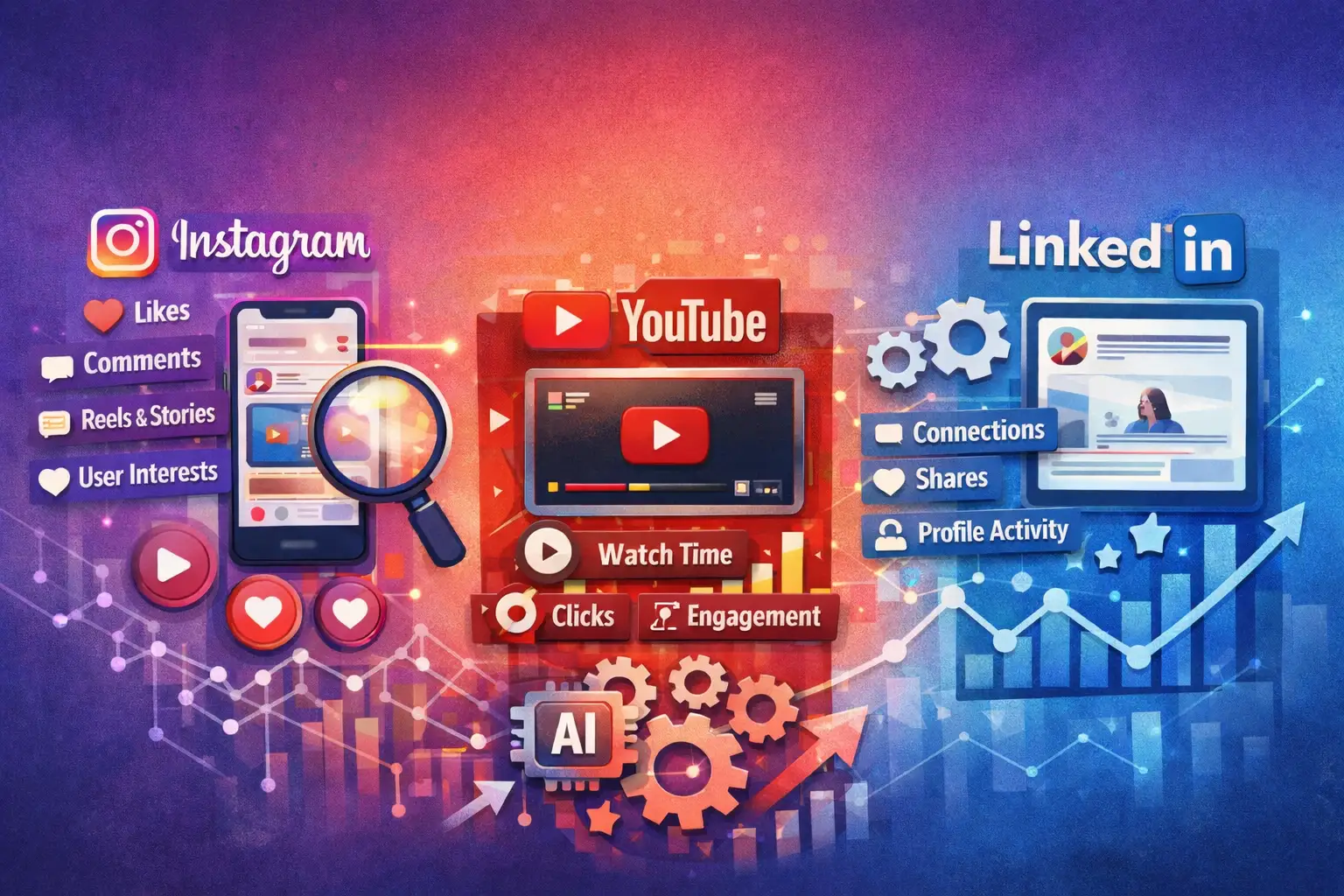
In 2026, social media algorithms no longer behave like static ranking formulas. They function more like decision-making systems that continuously learn from user behaviour. Every pause, swipe, rewind, share, or skip becomes feedback. Over time, this feedback trains AI models to predict not just what a user likes, but what they are most likely to engage with next.
This shift means platforms are no longer rewarding content simply because it performs well globally. Instead, they evaluate how well content performs for specific audience clusters. A post might explode in one niche and completely disappear in another – and that is by design.
For marketers, this changes the game entirely. Success is no longer about chasing mass appeal. It’s about earning relevance repeatedly within a defined audience.
Why Engagement Quality Matters More Than Reach in 2026
One of the biggest misunderstandings about social media algorithms is the idea that likes equal success. In reality, likes are now one of the weakest engagement signals across Instagram, YouTube, and LinkedIn.
Algorithms in 2026 prioritize engagement quality over engagement volume.
For example:
- A video watched till the end by 200 people can outperform a video liked by 2,000 people but abandoned after 3 seconds.
- A LinkedIn post with 15 thoughtful comments can outrank one with 300 likes and no discussion.
- A Reel saved repeatedly signals long-term value, pushing it further in Explore and Recommendations.
Algorithms interpret these behaviours as signs of content usefulness, not popularity. This is why many creators see fewer likes but higher reach – the system has learned that attention is more valuable than applause.
Instagram Algorithm in 2026: Relationship Graphs Over Follower Counts
Instagram’s algorithm in 2026 is built around relationship graphs, not follower numbers. The platform maps how users interact with each other over time and prioritizes content from accounts with stronger interaction histories.
If someone frequently:
- Watches your Stories
- Replies to your DMs
- Saves your posts
- Comments more than once
Instagram interprets that as a high-trust connection. Your content then appears more often in their Feed and Stories, even if you post less frequently.
This is why many smaller creators outperform larger accounts. The algorithm assumes that content from trusted relationships creates a better user experience than content from accounts users barely engage with
Why Reels Dominate Instagram Distribution
Instagram Reels are not favoured because they are trendy – they are favoured because they maximize time spent on platform.
Reels provide Instagram with:
- Faster content consumption
- Stronger emotional reactions
- Higher completion-rate data
- Better AI training signals
In 2026, the Reels algorithm evaluates videos based on viewer intent prediction. It asks questions like:
- Will this user finish the video?
- Will they replay it?
- Will they save or share it privately?
- Will they explore the audio or creator page?
If early viewers show strong signals, the algorithm expands distribution aggressively – first to similar interest groups, then to broader clusters.
This explains why some Reels suddenly “take off” hours or even days after posting.
YouTube Algorithm in 2026: Satisfaction Over Virality
The YouTube algorithm has evolved into a viewer satisfaction engine. While watch time still matters, YouTube now measures how satisfied viewers feel after watching.
This includes:
- Whether they continue watching related videos
- Whether they return to the platform later
- Whether they engage with comments
- Whether they subscribe after watching
In 2026, YouTube no longer rewards misleading thumbnails or exaggerated titles for long. If users click but leave quickly, the algorithm treats that as a negative satisfaction signal and reduces distribution.
This is why channels that build topical authority – consistently covering one subject deeply – perform better than channels chasing random viral trends.
LinkedIn Algorithm in 2026: Professional Relevance Scoring
LinkedIn’s algorithm now evaluates content through what can be called professional relevance scoring.
Before pushing a post widely, LinkedIn tests it with:
- First-degree connections
- Industry-adjacent users
- People who previously engaged with similar topics
If the content sparks meaningful interaction – such as thoughtful comments, saves, or shares – LinkedIn expands reach beyond the immediate network.
Importantly, LinkedIn devalues content that:
- Feels overly promotional
- Uses engagement bait
- Lacks clear professional insight
This explains why raw, experience-based posts often outperform polished brand announcements.
How AI Predicts What You’ll Like Before You Know It
One of the biggest algorithm shifts in 2026 is predictive content delivery.
Platforms no longer wait for users to search or engage explicitly. AI models analyse:
- Micro-behaviours (scroll speed, hover time)
- Cross-platform interests
- Topic overlap between users
- Consumption patterns at specific times of day
Based on this, algorithms surface content users are likely to enjoy – even if they’ve never interacted with that topic before.
This is why discovery feels more intuitive but also harder to control. Content now succeeds by aligning with emerging intent, not just existing demand.
Why “Posting More” No Longer Works
In earlier years, posting frequency could compensate for weak content. That is no longer true.
In 2026, excessive posting with low engagement actually damages distribution. Algorithms interpret repeated underperforming posts as a signal that audiences are losing interest.
Instead, platforms favor:
- Fewer, higher-quality posts
- Consistent value delivery
- Predictable content themes
This is why many high-performing accounts publish less often but achieve better reach.
The Real Reason Algorithm Changes Feel Random
Algorithm updates often feel sudden and unpredictable, but most changes follow a pattern:
- Platforms adjust models to reduce low-quality content
- AI thresholds are recalibrated
- New formats are prioritised to drive adoption
What changes is what the algorithm considers valuable, not whether it wants to punish creators.
Creators who focus on audience value tend to survive every update. Those who chase shortcuts feel the impact first.
Algorithms Are Audience Mirrors
Social media algorithms in 2026 do not reward tricks, hacks, or loopholes. They reflect how audiences behave.
If people:
- Watch your content fully
- Interact meaningfully
- Come back for more
Algorithms amplify you.
If they scroll past, ignore, or disengage, algorithms quietly move on.
That’s the real rule – and it hasn’t changed.
Frequently Asked Questions About Social Media Algorithms in 2026
How do social media algorithms work in 2026?
In 2026, social media algorithms work as AI-driven prediction systems, not fixed rulebooks. Instead of ranking content purely by likes or followers, platforms analyse user behaviour in real time -such as watch duration, scroll speed, saves, comments, and repeat views – to predict what content a person is most likely to engage with next.
This means algorithms don’t simply react to engagement; they anticipate interest. Content is shown to smaller audience clusters first, and if it performs well within those groups, distribution expands. Poor early engagement limits reach, regardless of follower count.
What has changed in social media algorithms in 2026 compared to earlier years?
The biggest shift in social media algorithms 2026 is the move from popularity-based ranking to relevance-based ranking.
Earlier algorithms rewarded:
- High follower counts
- Viral reach
- Like volume
Modern algorithms prioritise:
- Engagement depth (watch time, saves, shares)
- Content usefulness
- Topic consistency
- Trust and authenticity signals
This change explains why smaller creators and niche brands often outperform large pages with broad, unfocused content.
Which social media KPIs matter most for algorithms today?
Not all social media KPIs carry equal algorithmic weight in 2026. Vanity metrics still exist, but platforms rely more heavily on behavioural KPIs.
The most important algorithm-aligned social media KPIs include:
- Average watch time
- Completion rate (especially for video)
- Saves and bookmarks
- Shares (including private shares)
- Meaningful comments
- Repeat engagement from the same users
Metrics like reach and impressions are outcomes, not inputs. Algorithms first evaluate how people behave, then decide how far content should travel.
Why is short-form video marketing dominating algorithms in 2026?
Short-form video marketing dominates because it generates the strongest engagement signals for AI models. Platforms like Instagram and YouTube gain more behavioural data from a 15–30 second video than from static posts.
Short-form video allows algorithms to measure:
- Attention span
- Emotional response
- Completion likelihood
- Rewatch behaviour
This makes short-form content ideal for algorithm training, which is why formats like Reels and Shorts receive preferential distribution across platforms.
How does the Instagram algorithm work in 2026?
The Instagram algorithm in 2026 operates through multiple ranking systems, each designed for a specific surface: Feed, Stories, Explore, and Reels.
At its core, Instagram prioritizes:
- Relationship strength between users
- Past interaction history
- Video retention metrics
- Content originality
- Relevance to user interests
Instagram no longer rewards mass posting. Instead, it Favors creators who consistently deliver content that specific audiences actively engage with.
What is the biggest IG algorithm trend in 2026?
The most important IG algorithm trend in 2026 is the shift toward intent-based distribution.
Instagram now evaluates:
- Whether users are likely to finish watching a Reel
- Whether they might save it for later
- Whether the content inspires further action (profile visits, audio exploration)
This means success depends less on trends alone and more on creating content that matches viewer intent – whether educational, entertaining, or inspirational.
Does follower count still matter for social media algorithms?
Follower count has minimal direct impact on algorithmic reach in 2026. Platforms use followers mainly as a testing audience, not a guaranteed distribution channel.
If your followers don’t engage meaningfully with your content, algorithms reduce exposure. Conversely, high engagement from a smaller audience can trigger wider discovery beyond followers.
In short: engagement quality beats audience size.
How can brands align content with social media algorithms in 2026?
To align with modern algorithms, brands should focus on:
- Creating fewer but higher-quality posts
- Designing content around audience problems or interests
- Prioritizing short-form video where possible
- Measuring success using engagement-based social media KPIs
- Maintaining clear topical consistency across posts
Algorithms reward clarity. When platforms understand what your content is about – and who it’s for – distribution becomes more predictable.