
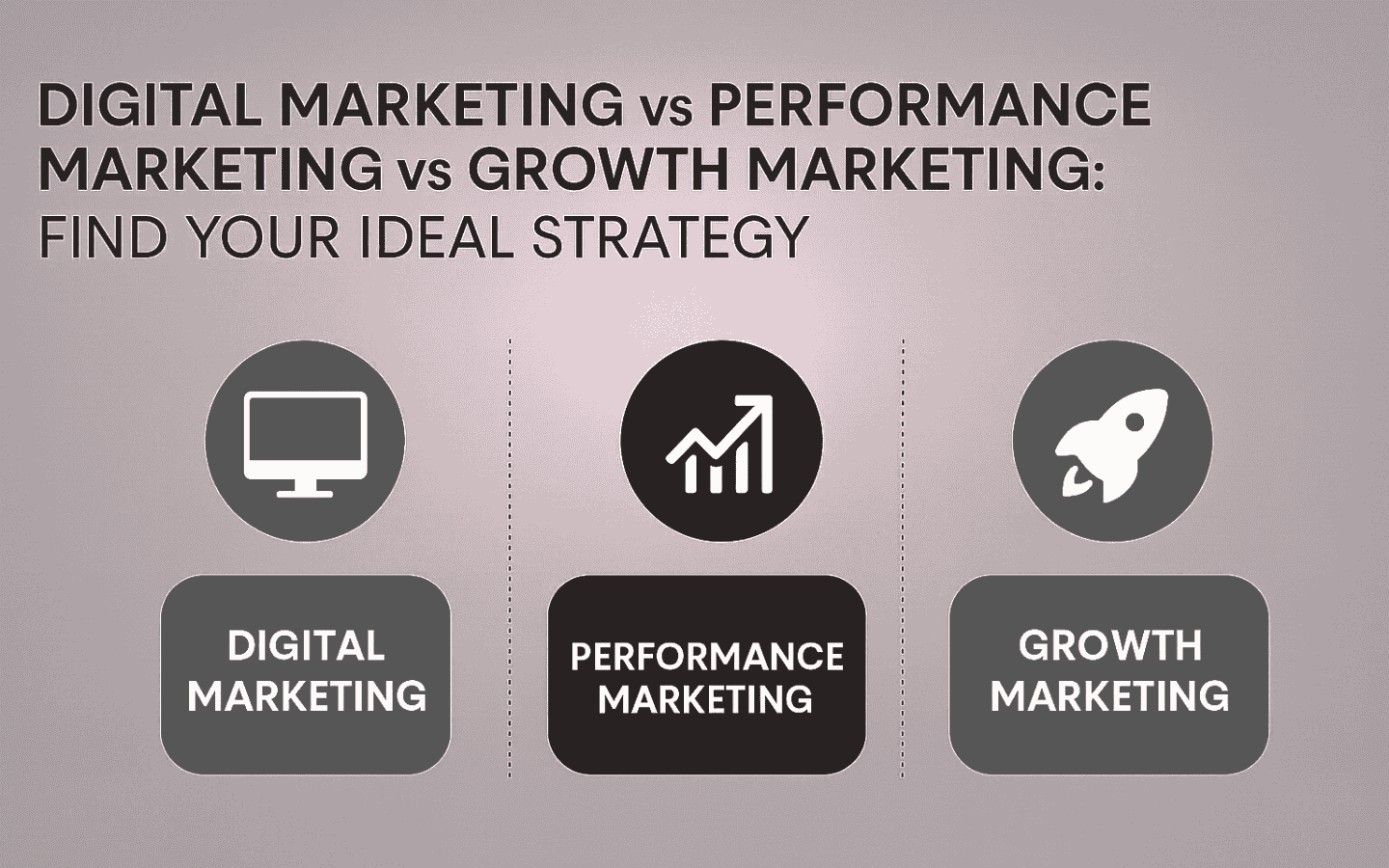
Digital Marketing vs Performance Marketing vs Growth Marketing: Find Your Ideal Strategy
In the modern, highly competitive digital environment, the correct digital marketing strategy is what can either break or make your business. Although classic content marketing and email promoting are pillars, the adoption of artificial intelligence-driven solutions has transformed the relationship between brands and readers.
Do you want to investigate performance-driven online marketing to benchmark ROI, develop end-to-end digital campaigns to create brand awareness, or use advanced growth marketing strategy practices to scale exponentially?
In each of these cases, you need to understand and be familiar with these specific techniques. Both methods have distinct benefits: digital marketing is used to create a wide audience, performance marketing provides traceable rates and results, and growth marketing ensures sustainable growth by utilizing trial-and-error-based data experiments and AI-based personalization at all customer contact points.
Understanding the Core Pillars of Modern Marketing
To develop an efficient, scalable strategy, you need to understand how different digital marketing strategies contribute separately to their outcome
Digital Marketing
This marketing refers to the umbrella that categorizes all messages that are on the net, such as search engine articles, posts on social media, podcasts, emails, and chatbots. It functions as the interest compound. All of the useful resources establish credibility in the long run, and they transform visitors into loyal buyers. However, the success does not come immediately; patience is the key here, as such digital assets require time to rank, spread, and bring long-term value.
Performance Marketing
Performance-based online marketing switches the pay model. You are only charged in cases where someone has clicked, completed a form, or purchased. The shared Channels are Google Ads, Meta campaigns, and cost-per-lead sponsorships. It is cost-effective, has limited budget wastage, and quick outputs. Nonetheless, increasing advertisement costs and minor brand-building capabilities are still existing issues.
Growth Marketing
This marketing format blends product optimization with continuous A/B testing across the customer journey. Small tweaks—like headline changes or referral perks—are tested in quick sprints. Winning strategies are scaled automatically, while ineffective ones are dropped. When a team embraces experimentation and learning, progress compounds week after week, steadily growing the user base.
Why Your Context Sets the Rules
Budget, business stage, audience size, and main goal act as the four levers that decide success. A lean wallet often favors pay‑per‑action ads, while deep pockets can nurture long‑form content. Early ventures crave fast users; mature brands chase lifetime value. Niche buyers need pinpoint ads; mass markets need broad stories. Clarify which dial matters most before spending a dollar.
Also read: Why Your Business Website Is Not Generating Leads (And How to Fix It)
Strategy Selection Matrix
Choosing the right marketing approach depends on your business goals, resources, and growth stage. Here’s how different strategies work best in specific scenarios:
App Launch Looking for Its First 10 K Users
Scenario
You just released a fresh mobile app and need rapid visibility before cash runs out.
Strategy
Growth marketing strategy takes center stage because every decision is treated as a live experiment.
Why It Works
Quick A/B tests uncover the messages, screens, or incentives that trigger word‑of‑mouth. The feedback loop is tight, so you waste little time on ideas that flop.
Signature Moves
Add referral rewards during onboarding, gate bonus features behind “share with a friend,” and tweak headlines weekly until one significantly increases sign-ups.
Bootstrapped Online Store Fighting Thin Margins
Scenario
A small e‑commerce brand sells niche products and must watch every dollar.
Strategy
Performance-based online marketing limits spending to clicks or confirmed sales, maintaining a stable cash flow.
Why It Works
Pay-per-sale (or cost-per-action payment systems): your expenses are indexed to revenues, and you only pay once buyers actualize their purchases. Such a guarantee is irreplaceable on small funds.
Signature Moves
Lean on Google Shopping feeds, retarget cart abandoners, and recruit affiliates who earn a fixed cut only after each conversion.
Regional School Seeking Long‑Term Credibility
Scenario
A private academy aims to earn the trust of its parents in its programs and values.
Strategy
Digital marketing strategy development, grounded in helpful, evergreen content, establishes authority over time.
Why It Works
Parents research thoroughly. In-depth post entries, online tourism, and professor question-and-answer sessions address questions before the inquiry form is even submitted, thereby gaining goodwill.
Signature Moves
Write SEO articles on curriculum options, schedule monthly webinars with teachers, and feature alumni’s achievements on social media.
Mid‑Size B2B Firm Aiming for Both Reach and Revenue
Scenario
An established software vendor needs both brand authority and a steady lead pipeline.
Strategy
A hybrid approach combines thought leadership content with precision paid campaigns.
Why It Works
Insightful articles attract organic traffic and nurture trust, while targeted LinkedIn ads convert warm readers into demos that sales can close.
Signature Moves
Release annual industry reports, repurpose insights into short posts, then remarket those readers with lead‑gen ads tied to white‑paper downloads.
Fresh Data You Should Know
Marketing budgets now equal 11.4% of overall company budgets, yet 63% of leaders still lack clear metrics. The global ad market is projected to reach $786 billion by 2026. WordStream and B2B digital spend alone are expected to reach $48 billion that year, according to eMarketer. On the tech side, 88% of marketers already use AI, and holding companies such as Publicis are investing heavily in automation, according to Business Insider.
How AI Enhances Every Play
AI tools write draft copy, predict ad bids, and personalize email flows for email marketing in minutes. Digital teams use AI briefs for quick keyword maps. Performance marketers rely on predictive bidding to raise ROAS. Growth squads deploy adaptive product tours that adjust in real time. Mastering these tools separates leaders from laggards..
Implementation Roadmap in Five Moves
- Define one success metric tied to revenue.
- Match the budget, stage, audience, and goal to the matrix above.
- Run a 90‑day pilot with weekly reviews.
- Scale winners, pause underperformers, and document the lessons learned.
- Decide to expand, pivot, or layer a second strategy.
When and How to Pivot
Knowing when to shift your marketing strategy is key to maintaining momentum and maximizing ROI. Here are some signs and strategies to guide your pivot:
Flat organic or social traffic for 8+ weeks?
This may mean the algorithm has cooled toward your content. To reignite reach:
- Inject a short burst of pay-per-click (PPC) ads.
- Audit and refresh outdated articles.
- Revisit keyword strategies.
Rising cost-per-lead with no change in conversion rates?
This suggests message fatigue. Time to test:
- New ad creatives or copy.
- Alternative landing page angles.
- Referral-based incentives.
Seasonal spikes (like Back-to-School or Black Friday)?
Don’t start from scratch—optimize and replenish existing evergreen content to meet demand while preserving long-term rankings.
Already achieved product-market fit?
Shift your growth team’s focus from acquisition to retention by:
- Introducing loyalty perks.
- Sending win-back emails.
- Hosting community events to turn customers into ambassadors.
Adapting early saves time and money—keep a close eye on performance signals and be ready to experiment smartly.
Deeper Dive: The Nuances Inside Each Strategy
Digital marketing compounds like interest, yet its strength depends on regular content audits, schema updates, and a consistent tone. Ignore maintenance, and even once‑top posts drift into page‑two obscurity.
Performance-based marketing services give you instant visibility, hence making the performance-based marketing strategies a worthy marketing tool to enhance business. Nevertheless, it is exposed to auction pricing changes and adjustments to regulations on privacy protection.
To mitigate risks, it’s essential to diversify across platforms and negotiate fixed-fee placements, creating a point of absorption that shields your strategy from price volatility.
The emergence of performance-based online marketing is a source of instant visibility, although it is vulnerable to inflation of auctions and changes in privacy; therefore, it is spread across platforms and has a fixed-fee placement negotiated as a point of absorption. Growth marketing leans toward learning as an alternative to vanity wins, yet the organizational culture should support failure; otherwise, experiments fail. Post-death scrutiny is done every week.
How Budget, Stage, Audience, and Goal Intersect
Picture a dashboard with four glowing dials, each guiding your business journey. The budget dial shows how far you can go—big budgets mean freedom to test, explore, and grow fast. But if you’re bootstrapping, every penny must earn its keep. Then there’s the business stage dial. Startups race ahead, hungry for quick insights and bold moves. Meanwhile, established brands move carefully, protecting their hard-earned reputation as they grow.
Targeting granularity depends on the size of the audience; focusing on a niche audience requires a specific message, whereas mass segments are designed to enjoy brand narration. Catch the main objective awareness, leads, or retention-focused, and all these tactics become tools that support the metric that matters the most in the present day.
Expanded Data Story
The 2025 State of Marketing AI Report projects that AI will guide 44% of marketing work within three years, according to the Marketing AI Institute. Single Grain reports that AI budgets are doubling year over year, while WordStream states that search still accounts for 40.9% of spend with a 12.2% CAGR. Data mastery now defines the competitive edge.
Exploring Hybrid Models
Growth processes by brands are usually in phases. A start-up activity may start with scrappy growth mechanisms and move to performance ads to fulfill monetization and eventually spend on content leadership to create long-term authority.
The developed companies can reverse that sequence, where the focus begins with the brand-building content and proceeds with performance-based strategies.
At every stage, it’s crucial to measure lift, what works, what fails, and what provides the fuel. Having an optimal allocation of tactics maintains revenue at an even level, allows continued product testing, and develops brand equity. This way, you can ride short-term surges without sacrificing the compounding value of growing a trusted, authoritative brand over time.
Common Mistakes and Highly Effective Shortcuts
Single‑channel dependence is risky; privacy updates can halve ROAS overnight. Diversify channels, select one key metric per funnel stage, and train teams across relevant skills to expedite the feedback process.
Timeline to Expect Results
Content may rank in six months, ads steady in two weeks, and growth tests show lift within a month. Set expectations early.
Sustainability and Future‑Proofing
First-party data, ethical AI, and agile teams build resilience as tracking cookies disappear and regulations tighten.
Chart Your Winning Marketing Path Forward
The primary point to consider is that the best marketers do not change their strategy to follow trends; instead, they adapt to the existing environment. Digital marketing creates belief, performance marketing ensures cash flow, and growth marketing defines quick wins; mix them as your stage, budget, and audience change.
Keep the matrix as your guiding star, tracking one important signal per funnel step, and switch when cues diverge. Power all the actions with ethical AI and first-party data, and your outcomes will be future-proof. Innovate, iterate, improve, repeat -because successful strategies are made through observing and planning, not through glamorous tools that produce an avalanche of short-term results that melt away overnight, but instead engage loyal customers who return to your brand year after year.