
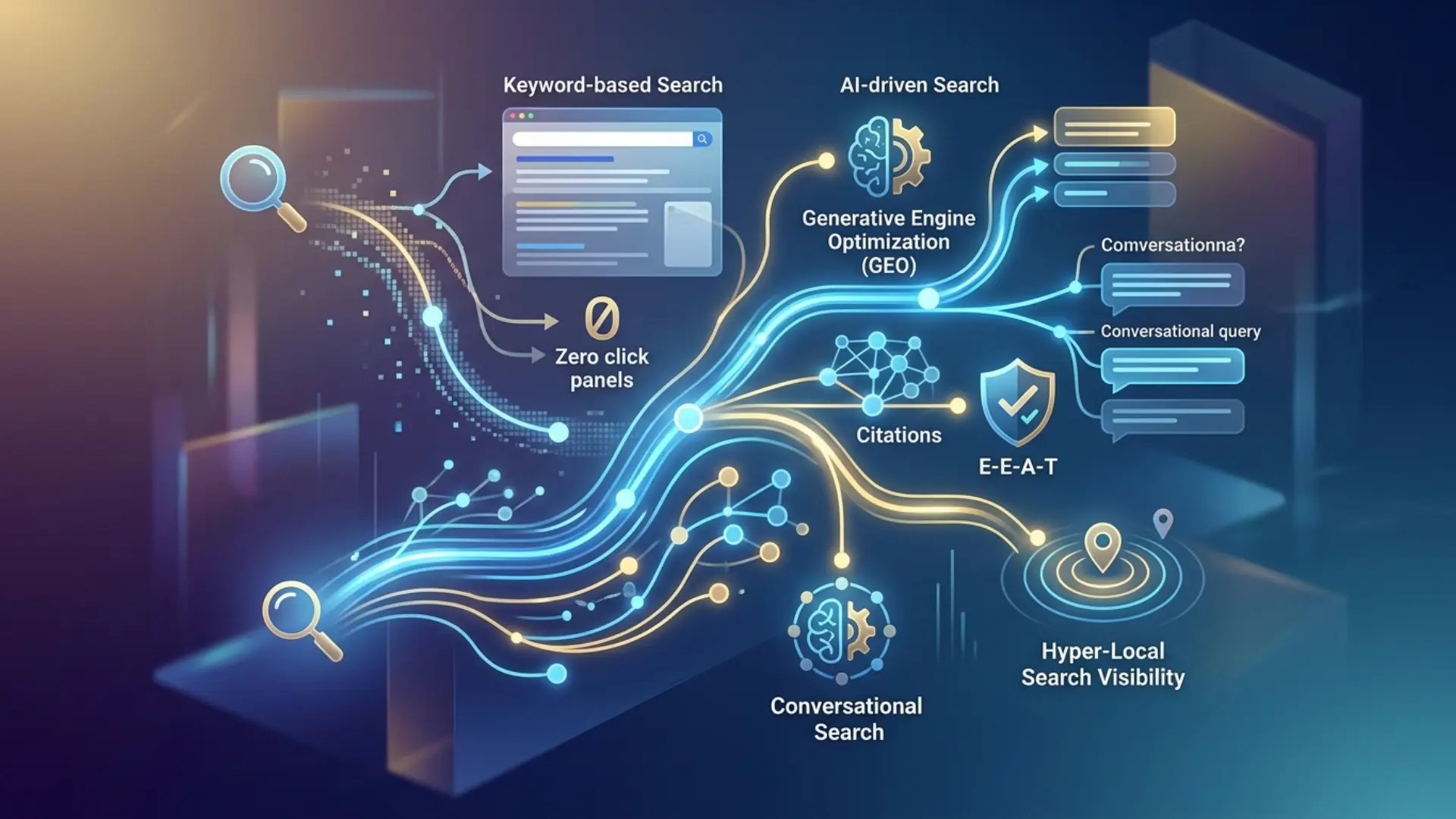
10 SEO Trends to Watch in 2026
AI is rewriting the rules of search. Here’s what’s actually changing – and the strategies that will keep you visible, cited, and trusted.
Search in 2026 doesn’t behave the way it did two years ago. Pages that followed every “best practice” are losing visibility. Sites with no obvious optimization are appearing everywhere. It looks random – but it isn’t. Search stopped being a directory and became a judgment system. This guide breaks down the 10 SEO trends that are reshaping how businesses get found, trusted, and chosen online.
- 60% of Google searches now end without a single click
- 527% year-over-year growth in AI search traffic
- 4.4× higher conversion rate from AI-referred traffic vs. organic
Before we dive into each trend, here’s the single most important mindset shift for 2026: Google – and every AI search system – no longer asks “Which page matches this keyword?” It asks “Which source explains this best and can be trusted?” That change explains everything else below.
AI-Driven Search Is Dominating - And It's Not Just Google Anymore
For decades, SEO meant one thing: rank on Google. That era is over. Search in 2026 happens across a growing ecosystem of platforms – Google, ChatGPT, Perplexity, Microsoft Copilot, and more. Each platform operates differently, evaluates content differently, and serves different types of users.
Google still processes roughly 14 billion queries daily – dwarfing ChatGPT’s 37.5 million. But trajectory matters more than raw volume right now. AI search traffic grew 527% in a single year, and 35% of Gen Z already uses AI chatbots as their primary search tool.
Key Insight "Only 14% of top-50 domains are shared across ChatGPT, Perplexity, and Google AI Overviews. Optimising for one doesn't automatically optimise for all three. You need a deliberate dual-discovery strategy."
For businesses and marketers, this creates a genuinely new challenge: you now have to earn visibility in two parallel discovery systems. The brands that master both will build compounding organic advantages that single-channel competitors simply cannot match.
What This Means for Your SEO Strategy
- Run a visibility audit across Google, ChatGPT, and Perplexity using your 10 most important buyer questions
- Structure every content piece for both traditional ranking signals and AI citation signals simultaneously
- Track branded search volume as a leading indicator of AI-driven awareness
Generative Engine Optimization (GEO) Is No Longer Optional
Generative Engine Optimisation – GEO -is the practice of structuring your content so that AI systems cite it in their generated answers. It has moved from a niche concept to an essential discipline in 2026.
GEO is fundamentally different from traditional SEO. Traditional SEO optimizes for ranking position in a list of links. GEO optimizes for citation within an AI-synthesized response. The content formats that rank well on Google aren’t always the formats AI systems prefer to cite.
“”Traditional SEO asks: how do I rank higher? GEO asks: how do I become the source AI systems trust enough to quote?””
Research from Princeton shows GEO techniques can boost visibility by up to 40% in AI responses. Content that includes specific statistics sees a 28% improvement in citation frequency. Referrals from large language models (LLMs) grew 800% year-over-year according to Semrush data.
What AI Systems Actually Look For
- Clear structure with direct answers leading each section (40–60 words)
- Specific statistics with source attribution
- High entity density – named concepts, tools, frameworks, and organizations
- FAQ-formatted content with question-based headings
- Consistent terminology across your entire content library
- Content that makes sense when read in isolation – detached from your website
The GEO Advantage
ChatGPT primarily cites lower-ranking pages – position 21 and below – about 90% of the time. This means a business with excellent, well-structured content but modest backlink authority can dominate AI citations even if it’s invisible on page one of Google.
Zero-Click Search Redefines What "Winning" Actually Means
Approximately 60% of all Google searches now end without a click. When AI Overviews appear, that number climbs to 83%. Google’s AI Mode – powered by Gemini – sees 93% of searches end with no external click at all.
Many marketing teams panic when impressions rise but traffic stays flat. That reaction misses what’s happening. Zero-click doesn’t mean zero-value – it means the model of how search creates business impact has fundamentally changed.
The Old Model vs. The New Model
| Dimension | Old SEO Model (Pre-2024) | New SEO Model (2026) |
|---|---|---|
| Primary Goal | Rank → Get Clicked → Convert | Get Cited → Build Trust → Convert When Ready |
| Success Metric | Traffic volume and click-through rate | Branded searches, citation frequency, engagement quality |
| Visibility Mechanism | Position on a list of links | Inclusion within a synthesized AI answer |
| Brand Impact | Clicks drove awareness | Impressions and citations drive recognition |
E-E-A-T Has Evolved from Guideline to Core Ranking Filter
Google’s E-E-A-T framework – Experience, Expertise, Authoritativeness, and Trustworthiness – is now arguably the most decisive ranking signal in 2026. And it has evolved significantly.
The internet is flooding with AI-generated content. By some estimates, 17.3% of content in Google’s top 20 results is now AI-produced. Google’s response has been to increasingly prioritize content that demonstrates what AI cannot fabricate: genuine firsthand experience, verifiable credentials, and real-world authority.
What Each E-E-A-T Signal Actually Means in Practice
- Experience: Content written by someone who has actually done the thing – not summarised what others have said about doing it
- Expertise: Depth that addresses nuances, trade-offs, and edge cases – not surface-level overviews
- Authoritativeness: Other credible sources reference you – this grows from being genuinely useful, not from self-promotion
- Trustworthiness: Clear authorship, accurate claims, transparent sourcing, and regularly updated information
Building Your E-E-A-T Infrastructure
- Create detailed author bios with credentials, social profiles, and expertise signals
- Add an editorial standards page explaining how your content is created and reviewed
- Include original screenshots, proprietary data, frameworks, and real examples in every piece
- Implement Author schema markup connecting authors to their full body of published work
Entity Authority Is Replacing Keyword Authority
Search engines and AI systems are increasingly evaluating websites through entity recognition rather than keyword matching. An “entity” is a distinct, identifiable concept – a brand, a person, a product, a topic – that search systems understand as a real thing in the world, not just a string of text.
Brands with strong cross-platform entity signals receive up to 10x more visibility in Google AI Overviews than competitors. The top drivers of AI Overview inclusion are branded web mentions, brand anchors, and branded search volume – all off-site signals that traditional SEO obsesses over far less than backlinks or keyword density.
Entity Authority vs. Keyword Authority
| Dimension | Keyword Authority | Entity Authority |
|---|---|---|
| Signal Type | Keyword Authority | Entity Authority |
| Built Through | On-page optimization, backlinks, rankings | Consistent cross-platform presence and brand mentions |
| How Fast | Can be bought or accelerated | Compounds slowly — difficult to replicate quickly |
| Defensibility | Low — competitors can outspend you | High — can't manufacture authentic web identity |
| AI Search Impact | Moderate correlation | Strong correlation with citation frequency |
Topic Clusters & Topical Authority Are the New Minimum
The era of targeting individual keywords with isolated pages is over. Google’s algorithms now evaluate whether a site demonstrates comprehensive, interconnected understanding of a topic – not just whether one page matches one query.
AI search systems amplify this further. When AI tools synthesize answers to complex questions, they prefer sources with deep, comprehensive topic coverage – because they provide a rich, cross-referenced knowledge base the AI can cite confidently across multiple related queries.
What a Topic Cluster Actually Looks Like
- One comprehensive pillar page covering a broad topic in depth
- 8–15 supporting articles addressing specific subtopics, questions, and use cases
- Strong internal linking – every supporting piece links to the pillar and to 2–3 sibling articles
- Consistent terminology used across the entire cluster
- Regular updates to keep the cluster current and authoritative
The Compound Effect
As your cluster grows, older pieces rank higher because new supporting content strengthens the entire network. Each new article inherits authority from the cluster it belongs to – rather than starting from zero. Topic clusters generate faster indexing, higher rankings, and greater AI citation likelihood than isolated content.
For smaller businesses and startups, this is actually great news: you don’t need to outproduce enterprise competitors across 50 topics. You need to comprehensively own 3–5 topics where you have genuine expertise. Depth beats breadth every time.
Local SEO in 2026: Hyper-Local Visibility Is Non-Negotiable
Local search is exploding. “Near me” searches, city-specific service queries, and hyper-local intent signals have become dominant patterns in how people find businesses. For service-based businesses and small businesses, local SEO trends in 2026 are the single biggest lever available.
A fully optimized Google Business Profile is no longer optional – it is table stakes. But optimization in 2026 means far more than filling in your address and hours.
Local SEO Best Practices in 2026
- Update your Google Business Profile weekly with posts, photos, and offers
- Respond to every review – positive and negative – within 48 hours
- Use local keywords naturally in your profile description and posts
- Build location-specific landing pages for every area you serve
- Ensure NAP (Name, Address, Phone) consistency across every directory
- Implement Local Business schema on your website with precise geographic data
Local + AI Search
AI systems are increasingly surfacing local businesses in response to conversational queries. A user asking ChatGPT “which accountant in Bengaluru specializes in startup taxes?” needs structured, consistent entity data to recommend your business confidently. Local SEO and entity optimization are now the same discipline.
Conversational & Voice Search Intent Is the New Keyword Research
Search queries don’t look like keyword fragments anymore. They sound like how people actually speak. Voice search now represents 20% of all queries and growing. Users no longer type “SEO agency Bengaluru” – they ask “which SEO agency in Bengaluru has experience with e-commerce startups and transparent pricing?
This shift is amplified by AI search interfaces that invite full, natural-language questions. Users are learning to ask complete questions, and they expect complete, context-aware answers in return.
Why Conversational Intent Favors Specific Businesses
- Conversational queries are far more specific – and specificity signals stronger buying intent
- Long-tail, intent-based queries are less likely to be fully absorbed by AI Overviews
- Enterprise competitors optimize for high-volume head terms – the conversational long-tail is wide open
- Voice search content naturally aligns with GEO optimization – direct answers, conversational tone
User-Generated Content & Community Trust Are Gaining Search Weight
Search engines are increasingly behaving the way users do when they want to verify something before trusting it – they look for what other people are saying. Reviews, Reddit threads, community discussions, and real user comments often answer questions more honestly than any brand page ever could.
They surface the details that matter to real buyers: what surprised someone, what didn’t work as advertised, what you only discover after using the product for six months. Search engines are paying attention to exactly this kind of signal.
Brands that try to control every word in every channel tend to struggle. Brands that facilitate honest conversation, respond transparently, and welcome criticism tend to build more durable trust – and more sustainable visibility.
Multi-Platform Search Is Now the Reality
- YouTube for visual walkthroughs and demonstrations
- Reddit for community reviews and candid comparisons
- LinkedIn for professional credibility and thought leadership
- Instagram and short-form video for discovery and awareness
- Niche forums and communities for category-specific trust
Platform Expansion
SEO in 2026 extends beyond your website. Visibility is shaped by your presence on every platform where your audience searches. If a platform influences how people research or decide – search exists there. Treating SEO as something that only happens on your website is no longer realistic
Technical SEO Is the Foundation - Not a Differentiator
Only 40% of websites pass Core Web Vitals thresholds. That means 60% of sites are failing the technical basics – and no amount of strategic content work can compensate for a site that Google can’t properly crawl, index, or render.
But here’s the important distinction for 2026: technical excellence enables visibility, but it doesn’t create it. Having fast load times, proper schema markup, mobile-first design, and correct indexing is the minimum viable foundation – not a competitive advantage in itself. The competitive advantage comes from what you build on top of that foundation.
The Technical SEO Checklist for 2026
- Core Web Vitals passing: LCP under 2.5s, INP under 200ms, CLS under 0.1
- Mobile-first design with fast load times on 3G connections
- Schema markup implemented: Organization, Article, FAQPage, BreadcrumbList, LocalBusiness
- XML sitemap current and submitted to Google Search Console
- Robots.txt not blocking AI crawlers (Googlebot, GPTBot, PerplexityBot)
- Internal linking structure that reflects your topic cluster architecture
- HTTPS, canonical tags, and clean URL structure throughout
Schema as AI API
Structured data in 2026 is your API contract with both search engines and AI systems. FAQPage schema, Article schema with proper author attribution, and Organization schema with sameAs properties all serve as machine-readable signals that help AI systems understand, extract, and cite your content with confidence. Without schema, AI systems depend on context alone – and can misidentify your content or skip it entirely.
2026 SEO Strategy Checklist
- Run a dual visibility audit across Google, ChatGPT, and Perplexity
- Implement GEO techniques: direct-answer leads, statistics, FAQ schema
- Add AI citation KPIs alongside traditional traffic metrics
- Build E-E-A-T signals: author bios, editorial standards, original data
- Create Organization and Author schema with sameAs cross-platform links
- Map your topic cluster architecture before publishing new content
- Optimize your Google Business Profile for local and AI search
- Reframe keyword research around full conversational questions
- Establish a value-first presence on 2–3 platforms your audience trusts
- Pass Core Web Vitals and implement essential schema types
FAQ-
Is SEO still relevant in 2026?
Yes – more than ever, but in a fundamentally different way. SEO has evolved from keyword ranking to earning trust from both Google’s algorithm and AI citation systems. Businesses that adapt to this dual-discovery environment will see compounding organic advantages; those that don’t will lose visibility steadily to competitors who do.
What is GEO and how is it different from SEO?
GEO stands for Generative Engine Optimization. Traditional SEO optimizes for ranking positions in a list of search results. GEO optimizes for citation within AI-generated responses – the goal is to be the source that ChatGPT, Perplexity, or Google AI Overviews reference when synthesizing an answer. The tactics overlap significantly, but GEO adds specific requirements: statistics inclusion, direct-answer formatting, FAQ schema, and cross-platform entity consistency.
What is E-E-A-T in SEO 2026?
E-E-A-T – Experience, Expertise, Authoritativeness, and Trustworthiness – is Google’s framework for evaluating whether content deserves to rank and be shown. In 2026, as AI-generated content floods the internet, E-E-A-T signals have become even more critical. Content that demonstrates genuine firsthand experience, verifiable credentials, and real-world authority consistently outperforms generic AI-summarized content.
What is zero-click search and does it hurt my business?
Zero-click search occurs when users get their answer directly on the results page – via featured snippets, AI Overviews, or knowledge panels – without visiting any website. In 2026, roughly 60% of searches end this way. For businesses, this isn’t purely bad news: brands cited within AI Overviews earn 35% more organic clicks than those not mentioned, and zero-click visibility builds brand recognition that drives future direct searches and conversions.
How do I rank on Google in 2026?
Focus on: creating genuinely useful, expert-level content with original insights; building E-E-A-T signals through verified authorship and real experience; targeting topic clusters instead of isolated keywords; implementing full schema markup including FAQPage and Organization schema; optimizing for conversational search intent; and earning entity authority through consistent cross-platform brand presence.
Is keyword research still important in 2026?
Yes, but the approach has shifted. Exact-match keyword targeting matters less than understanding search intent and conversational query patterns. Use keyword research tools alongside Google Trends and question-research tools like Also Asked to understand the complete questions your audience asks – then build content that answers those questions comprehensively and directly.